
Part of a series
Why a Rental Sits EmptyA hub article and four follow-ups for owners who manage their own rentals. Each follow-up covers one step of the hub's checklist.
There’s no fixed number of weeks that means trouble. A reasonable vacancy depends on the month and on the kind of renter your property draws. Nationally, Apartment List estimates that renters searching in summer face 20% to 30% more competition than renters searching in winter. Three weeks empty in July can be a problem. The same three weeks in December usually aren’t.
Apartment List puts summer competition 20% to 30% above winter’s. Rents follow the same curve: they peak in June and July, and the national median falls about 1.6% from that peak to its November low. At the current national median of about $1,390 a month, that’s roughly $20 to $25. In summer, more people are looking and landlords have more leverage. In winter, fewer people are looking at all.
Check this: Before deciding your price is wrong, note which month you’re in and where it falls on Apartment List’s seasonal curve.
Local property managers describe Colorado’s peak rental season as May through August. Neither local source puts a number on how much more competitive the peak is. Monthly rent data exists for the Denver metro and Fort Collins, from Apartment List and Zillow among others, but no one publishes a local version of the 20% to 30% figure. So the national percentage is the best number we can get here.
Check this: Use May through August as Colorado’s peak, and treat the national 20% to 30% as a rough measure of how much busier it is, not a local fact.
This is where many timing mistakes happen. We saw it in Fort Collins. A landlord bought an older five-bedroom house in January and listed it for rent in February. It sat, even after a price reduction, until May, and then leased quickly.
The house wasn’t the problem, and in the end neither was the price. The calendar was. An older five-bedroom in that part of town rents like a student house, and in February very few people in that group are looking. By May, many more are: most students sign months ahead for August, but a fair number still look for a May start. A newer house near the interstate, the kind a professional relocating for a job might rent in February, would have had a very different winter.
The two main calendars:
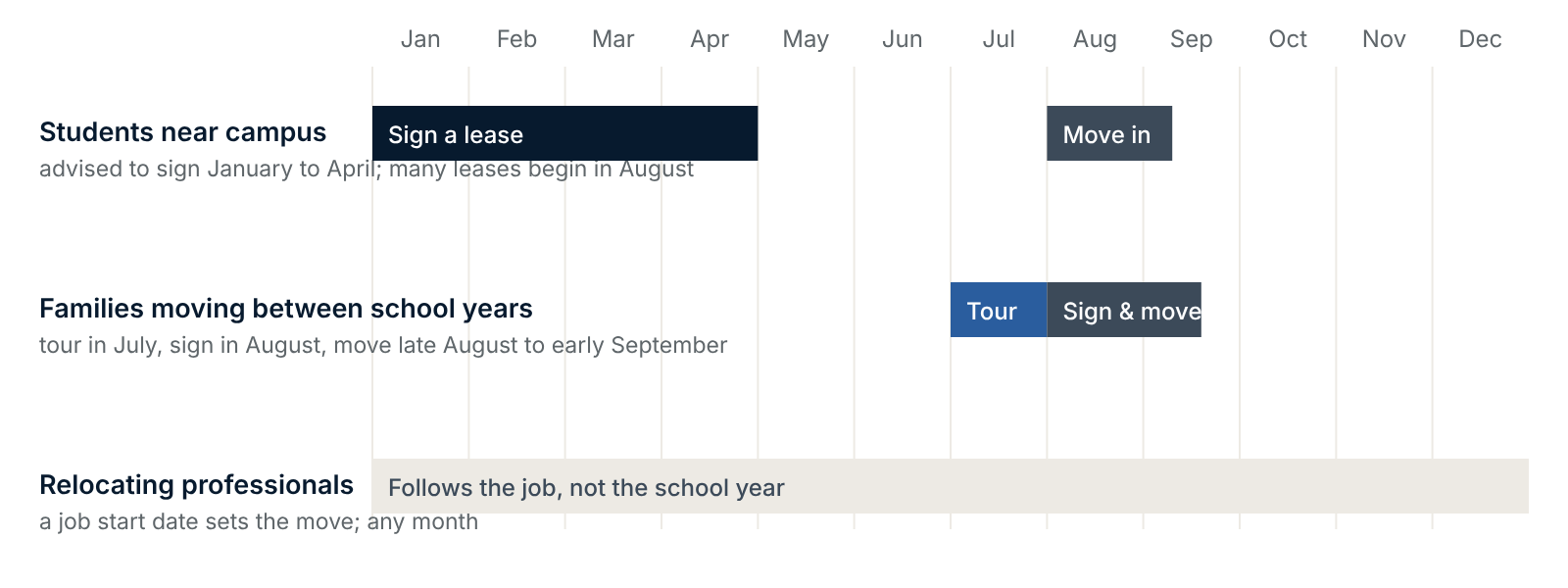

So a student-style rental still unleased in June has probably missed most of its season, while a family house unleased in June is right on schedule. Apartment List advises renters moving for school to start searching 90 or more days ahead, because competition spikes around campus areas. That fits the student calendar above.
Check this: Decide which calendar your property follows, student, family or relocating professional, and judge its vacancy against that one. The student calendar is laid out by Fort Collins Real Estate; the family calendar by moveBuddha.
Apartment vacancy in the Denver metro reached 7.6% at the end of 2025, its highest in 16 years. It has eased since, but in the second quarter of 2026 apartment rents were still about 5.5% below a year earlier, according to CBRE, so apartment owners had less of their usual summer leverage. Single-family houses held up better: in June, the Denver Metro Association of Realtors reported single-family rents about 3% below a year earlier, against about 9% for apartments.
Check this: If you own an apartment in the Denver metro, expect less seasonal leverage than usual before concluding that your price is the problem. CBRE’s quarterly figures show where rents stand.
Whether a vacancy has gone on too long comes down to two things: the month, and the kind of renter your property draws. Get both right before you lower the rent. It can save an unnecessary cut, and it can reveal a real problem the calendar was hiding.
Wondering what your rental could rent for? We’ll send you a rental analysis for your property. Call or text 720-964-1151. Download this article as a PDF.

This article is general information for rental owners and residents in Colorado, not legal advice. Laws and local rules change; check the "Reviewed" date above and confirm current requirements with an attorney before acting. Urban Forest Property Management LLC · Colorado real estate brokerage · License EC.100111715.
Photographs created with Grok.
.svg)